
Loading Studio Assets...
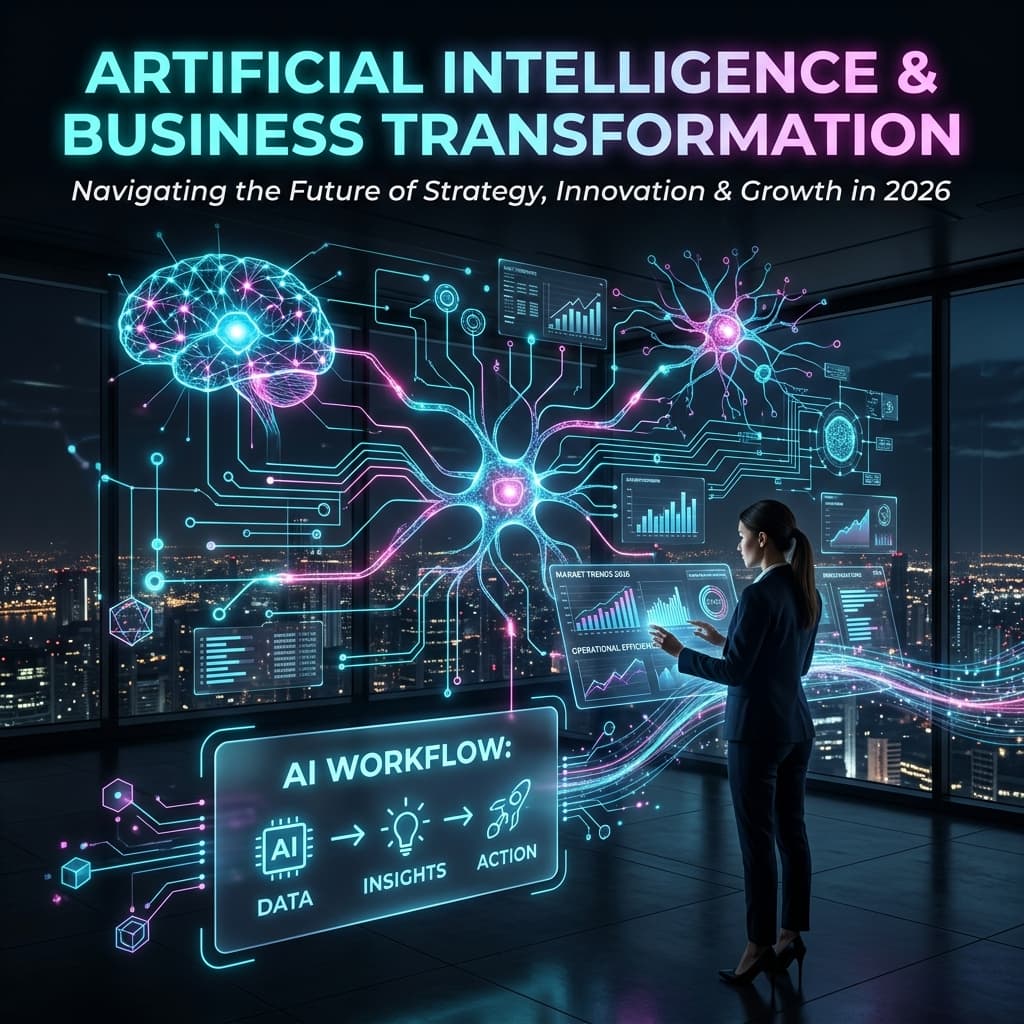
Artificial intelligence in 2026 is no longer just about generating clever text snippets or novelty imagery. It has matured into the operational backbone of high-growth enterprises and forward-thinking local businesses alike.
From autonomous customer support agents to predictive inventory systems and AI-assisted content engine pipelines, businesses that integrate AI into their core operations are seeing massive leaps in efficiency and margin expansion.
Five years ago, business AI adoption was limited to simple decision trees and basic chatbots. Today, Agentic AI systems execute multi-step workflows autonomously:
AI models are only as good as the data fed into them. Modern businesses are restructuring legacy databases into clean, structured vector embeddings so internal LLM agents can query internal knowledge bases accurately.
Search engine behavior has fundamentally changed. Customers now use ChatGPT, Perplexity, and Gemini to discover brands. Optimizing your brand for AI recommendation engines (using llms.txt and schema markup) is now as crucial as traditional Google SEO.
The most effective AI systems do not replace human workers; they amplify them. By establishing clear human review steps for high-stakes tasks, companies achieve speed without sacrificing accuracy or brand integrity.
Off-the-shelf models are great for general tasks, but domain-specific fine-tuned models trained on proprietary business data provide a defensible competitive moat.
| Feature | Traditional Automation | Modern Agentic AI (2026) |
|---|---|---|
| Logic | Rigid, rule-based (if/else) | Flexible, contextual reasoning |
| Input Handling | Formatted structured data only | Unstructured text, audio, images, code |
| Adaptability | Breaks on unexpected inputs | Self-corrects and iterates autonomously |
| User Interaction | Form fills & buttons | Natural conversational interface |
| Execution | Single pre-set task | Multi-step task planning & tool usage |
At Brandomize, we help businesses navigate the fast-moving AI landscape with custom-built digital solutions. Whether you need an AI-ready high-performance website, automated lead generation funnels, or specialized digital marketing campaigns, our team builds infrastructure designed for modern growth.
Ready to transform your business operations with cutting-edge digital systems? Get a custom quote today or explore our digital agency services.
We help founders, brands, and local businesses turn modern tech into measurable revenue and standout brand identity.
As the internet drowns in recursive synthetic sludge, artificial intelligence is eating its own tail—triggering irreversible model collapse and epistemic decay.
OpenAI CFO Sarah Friar argues proprietary models beat open source on total cost of ownership, citing an 80% Luna price cut and useful intelligence per dollar.