
Loading Studio Assets...
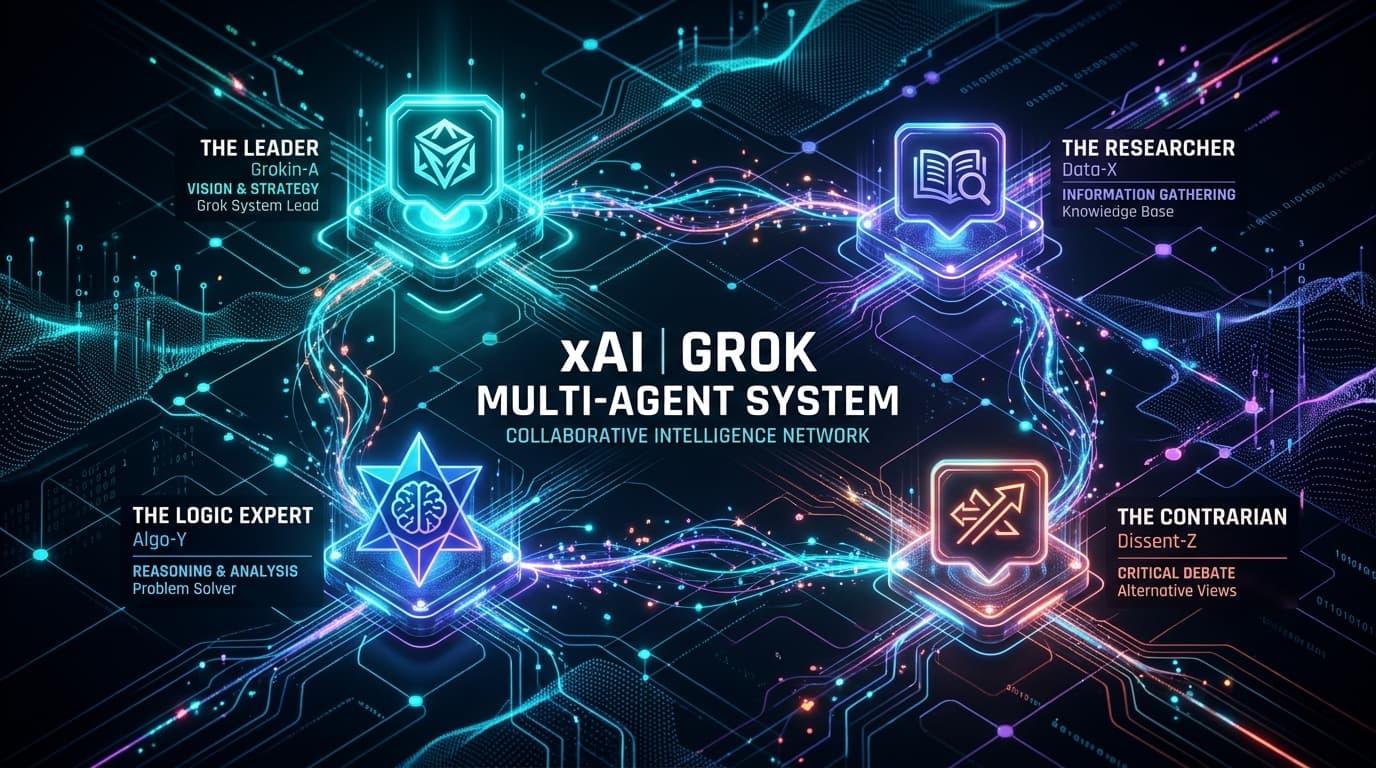
Artificial intelligence is undergoing a massive shift from single-model "chain-of-thought" generation to multi-agent collaborative reasoning. Leading this charge is xAI with its groundbreaking Grok 4.20 Multi-Agent Architecture and the ultra-compute Grok Heavy mode.
Instead of relying on a single neural network to answer a query from start to finish, Grok now deploys a specialized team of AI agents that debate, verify, and cross-examine data in real time before delivering a final response.
Here is a deep dive into how xAI’s new multi-agent system works, the four key personas that drive it, and what this means for the future of AI-powered applications and digital tools.
Traditional Large Language Models (LLMs) operate like a single genius in a room—they generate tokens sequentially based on probabilistic patterns. However, complex real-world queries (such as financial modeling, multi-step code refactoring, or real-time news verification) often cause single models to hallucinate or miss edge cases.
xAI's multi-agent framework solves this by introducing adversarial consensus. Multiple agents work on the same problem simultaneously, sharing intermediate reasoning steps and intentionally challenging one another's conclusions. Internal benchmarks indicate this multi-agent consensus approach dramatically slashes hallucination rates from ~12% down to 4.2%.
In standard multi-agent mode, Grok 4.20 spawns four specialized agents. While they leverage a shared underlying weight architecture for computational efficiency, each agent is fine-tuned with distinct system prompts, objective functions, and behavioral parameters:
For tasks requiring massive depth—such as analyzing dense scientific papers, running deep competitive intelligence audits, or writing complex multi-file codebase updates—xAI offers Grok Heavy.
In Heavy mode, the architecture scales from 4 to 16 parallel agents. Multiple research agents query different facets of the web simultaneously, while multiple logic and contrarian agents battle-test edge cases in parallel execution lanes. Though it incurs higher latency and compute overhead, Heavy mode achieves unprecedented scores on benchmark tests like Humanity's Last Exam (HLE).
A major innovation of Grok’s architecture compared to framework-level agent frameworks (like CrewAI or AutoGen) is shared weight efficiency.
Rather than booting up 4 or 16 separate, heavy LLM instances (which would explode RAM and token costs), Grok utilizes multi-head specialization over shared core weights. The agents act as distinct cognitive persona heads within the same infrastructure, making real-time collaboration ultra-fast and scalable for enterprise API usage.
The launch of Grok's multi-agent architecture signals that the future of enterprise software is not just "chatbots," but autonomous agent teams. Businesses can now build systems that:
At Brandomize, we help modern brands and tech startups build intelligent, high-performance web platforms and integrate cutting-edge AI architectures.
Whether you need custom Next.js applications, seamless AI agent integrations, or high-converting digital branding that stands out in the AI era, our expert team in Hisar and global clients trust us for speed and perfection.
Ready to upgrade your digital strategy? Explore our custom agency solutions at Brandomize today!
We help founders, brands, and local businesses turn modern tech into measurable revenue and standout brand identity.
As the internet drowns in recursive synthetic sludge, artificial intelligence is eating its own tail—triggering irreversible model collapse and epistemic decay.
OpenAI CFO Sarah Friar argues proprietary models beat open source on total cost of ownership, citing an 80% Luna price cut and useful intelligence per dollar.