
Loading Studio Assets...
For the first three years of the generative AI boom, the industry was obsessed with prompt engineering. We crafted long system instructions, tested few-shot examples, and fine-tuned temperature parameters trying to get LLMs to produce the perfect answer in one shot.
But for complex tasks—like building a web app, conducting investment research, or managing database pipelines—one-shot prompting inevitably fails.
Today, the leading edge of AI development is shifting from prompting to loop engineering. Products like Claude Code, ChatGPT’s Advanced Voice/Data systems, and agentic platforms like Mira are succeeding because they stop prompting, and start looping.
Here is everything you need to know about the architecture of agentic loops—and what nobody tells you about deploying them.
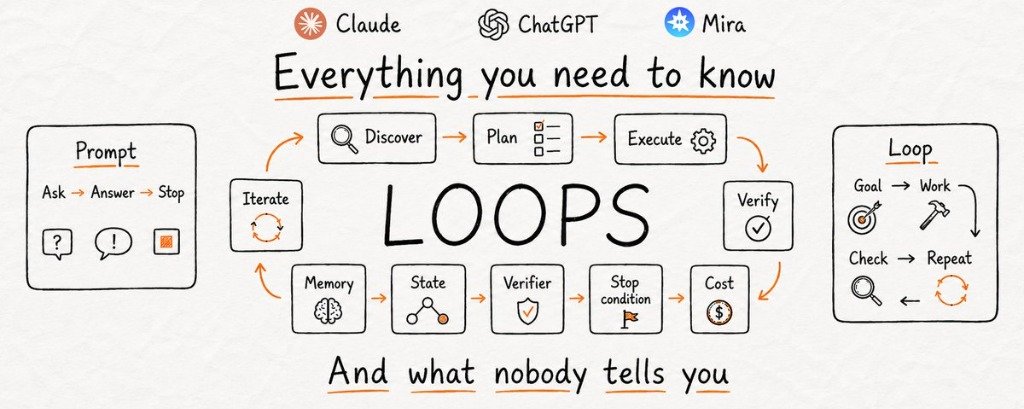
To understand why loops are dominating, we must look at the difference in execution architectures:
Ask -> Answer -> StopGoal -> Work -> Check -> RepeatBuilding a robust agentic loop requires more than putting an LLM in a while loop. A production-grade loop architecture (like the one shown in the diagram) consists of ten vital components:
Before executing any work, the agent must inspect its environment. It queries system directories, checks database schemas, searches the web, or parses incoming files to understand the starting parameters.
Once the environment is understood, the model maps a structured plan. It breaks the main goal into small, sequential checklists (e.g., "Step 1: Check dependencies, Step 2: Write test file, Step 3: Run test").
This is the tool-calling phase. The LLM executes code, invokes external APIs, triggers bash scripts, or runs web-browsing containers. It performs actual, physical work on the system.
After executing, the agent checks the output. Did the bash command succeed? Did the code compile? Verification tests verify the outputs against expectation, capturing logs or errors.
Every loop iteration costs money. The architecture tracks latency, token usage (input/output/cached), and api calls. If the loop is too expensive, it scales back or switches to a cheaper model.
To prevent runaway loops from spending thousands of dollars on infinite recursive cycles, strict boundaries are set. These include maximum step counts, token budget limits, or a successful verification check.
A dedicated "judge" model or safety shield reviews the actions. It audits the code or decisions to ensure they align with the system rules and data residency policies.
The central coordinate tracker. The State holds variables, active file paths, directory parameters, and the overall status of the checklist.
Maintains long-term context across loop cycles. It stores past successes, failures, and intermediate context keys, ensuring the model doesn’t repeat identical mistakes.
Feedback is fed back into the Discover phase, adapting the plan based on the results of the verification check, starting the cycle anew.
While building agentic loops sounds straightforward, developers deploying them in production face major hidden realities:
1. Loops are extremely latency-heavy: A linear prompt takes 2 seconds. A loop that iterates 15 times can take 2 minutes. Designing fast local inference models (like Qwen or Llama running on edge GPUs) is crucial to keeping loop latency usable.
2. Error propagation is real: If your verifier makes an error in step 3, that error compounds in subsequent iterations. Building deterministic, rule-based validators alongside LLM judges is mandatory for reliability.
3. Token caching is your financial savior: Since each iteration sends previous context back to the model, API bills grow exponentially. Implementing dynamic context caching (like Anthropic's prompt caching) is the only way to make high-volume loops financially viable.
Stop prompting. Start engineering. Brandomize helps businesses build and deploy custom agentic loops, automate complex backend workflows, and connect LLM reasoning engines with local infrastructure safely and affordably. Connect with us to automate your business operations today.
We help founders, brands, and local businesses turn modern tech into measurable revenue and standout brand identity.
Kya tumhara business raat mein customer calls miss karta hai? Ek AI chatbot banao jo 24 ghante jawab de — bilkul free, bina ek line code likhe.
Ek system banao jo tumhare liye kaam kare jab tum so rahe ho. Zapier, Make, aur AI tools se koi bhi apna automatic system bana sakta hai — bilkul free.