
Loading Studio Assets...
Elon Musk’s xAI (now frequently aligned under the SpaceXAI banner) has officially launched Grok 4.5.
Instead of chasing general trivia benchmarks, this release is laser-focused on where AI actually does commercial work: coding, system operations, and multi-step agent execution. By building on their new V9 foundation model architecture and training directly on Cursor developer telemetry, xAI has delivered an "Opus-class" model that challenges Anthropic and OpenAI on pure developer workflows.
But the real story isn’t just the benchmarks—it’s how Grok 4.5 achieves them. Here is a developer-focused, hype-free analysis of the architecture, the performance metrics, and the math behind its token efficiency.
Previous versions of Grok relied on the V8-small framework, which was fast but struggled with deep reasoning and edge-case code syntax. Grok 4.5 is a ground-up redesign:
At launch, Grok 4.5 was benchmarked against the absolute best reasoning engines in the industry, including Anthropic’s Claude Opus 4.8 and OpenAI’s GPT-5.5.
Here is how they stack up in the latest agentic and software engineering evaluations:
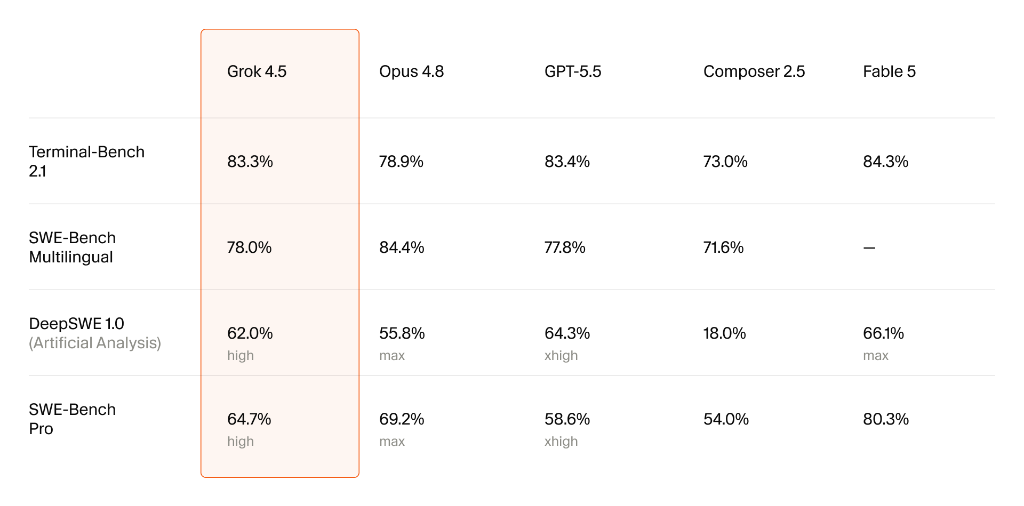
On sysadmin and shell scripting tasks, Grok 4.5 scores 83.3%, running neck-and-neck with GPT-5.5 (83.4%) and clearly beating Claude Opus 4.8 (78.9%). It lags slightly behind Fable 5 (84.3%), but represents a highly capable agentic core for terminal operations.
When managing codebases across python, typescript, go, and rust, Grok 4.5 handles 78.0% of tasks successfully. It beats GPT-5.5 (77.8%) but sits behind the multilingual powerhouse Opus 4.8 (84.4%).
DeepSWE evaluates an AI agent's ability to parse issues, write git patches, and run unit tests. Grok 4.5 resolves 62.0% of issues, comfortably ahead of Opus 4.8 (55.8%) but trailing GPT-5.5 (64.3%) and Fable 5 (66.1%).
On the hardest evaluation containing complex production bugs, Grok 4.5 resolves 64.7% of tasks, easily outperforming GPT-5.5 (58.6%) but behind Opus 4.8's high-water mark of 69.2%.
If you have used Claude or ChatGPT for coding, you know they can be incredibly verbose. They explain their thoughts, write extensive boilerplate, add comments to explain basic syntax, and write code that takes hundreds of lines to solve a simple problem.
For humans, this is mildly annoying. For autonomous AI agents, it is a disaster:
xAI’s core focus for Grok 4.5 was Token Efficiency.
Through RL (Reinforcement Learning) optimized with a "minimal operations" reward function, Grok 4.5 has been trained to output the absolute shortest code patch required to solve a problem. It skips conversational fluff and comment headers, writing directly to the target diff.
According to xAI’s internal logging on SWE-Bench Pro, Grok 4.5 solves tasks using 4.2x fewer output tokens compared to Claude Opus 4.8.
For an enterprise running automated coding agents, this translates to:
To drive adoption, xAI is positioning Grok 4.5 as a high-margin, low-cost developer endpoint:
Combined with the 4.2x token reduction, the actual cost of running Grok 4.5 in a developer agent workflow can be up to 10x cheaper than running Claude Opus 4.8.
Grok 4.5 isn’t a magic bullet. If you need highly creative, conversational copy or complex multi-lingual document translation, Claude Opus remains the gold standard.
However, if you are building autonomous software agents, running terminal workflows, or using Cursor for fast code generation, Grok 4.5’s V9 architecture and token-minimization training make it an incredibly strong—and highly affordable—contender.
Build faster, run cheaper. Brandomize helps tech-forward companies implement custom coding workflows and agentic pipelines using frontier models like Grok 4.5 and Claude. Reach out to optimize your AI infrastructure costs today.
We help founders, brands, and local businesses turn modern tech into measurable revenue and standout brand identity.
AWS signed a multiyear deal with vibe-coding startup Superblocks to run AI app-building inside customers' own private clouds — so 'data never leaves.' Here's why it matters.
Engineers no longer type most code by hand — they describe intent and agents do the work. Here's how the three leading agentic coding tools differ in 2026.