
Loading Studio Assets...
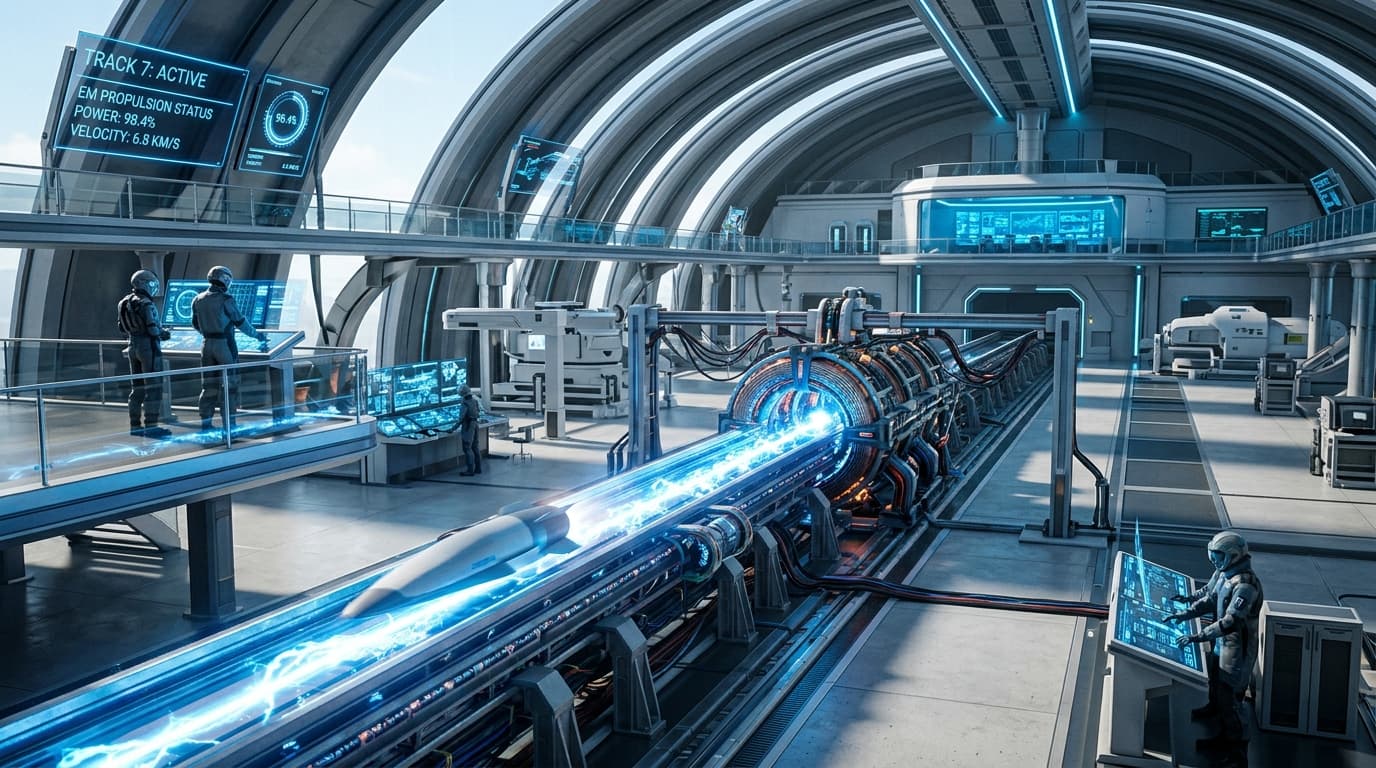
In a series of rapid disclosures across defense journals, state laboratories, and academic preprints in 2026, China has pulled back the curtain on an unprecedented wave of next-generation physical and computational systems.
From compact, flashless electromagnetic rail launchers to 156-satellite orbital debris tracking networks and neuromorphic edge-AI processors, these unveilings mark a distinct strategic pivot: moving away from incremental commercial copycatting toward deep-tier foundational engineering.
Here is a comprehensive breakdown of what was revealed, the core engineering mechanics behind the breakthroughs, and how this alters the global technology landscape in 2026 and beyond.
The recent wave of disclosures spans four distinct high-technology pillars:
| Domain | Unveiled Technology | Core Capability | Strategic Significance |
|---|---|---|---|
| Electromagnetic Propulsion | Compact EM Rail Launchers | High-velocity muzzle discharge with near-zero flash and acoustic dampening | Replaces chemical propellant with solid-state pulsed power capacitors |
| Edge & Neuromorphic AI | "Emei" Neuromorphic VPU & ASIC Blocks | Brain-inspired spiking neural network (SNN) computation for edge robotics | Operates under strict power constraints without Western GPU reliance |
| Orbital Space Infrastructure | 156-Satellite "EYESAT" Constellation | High-precision orbital debris tracking and automated collision avoidance | Establishes autonomous spatial domain awareness over low Earth orbit (LEO) |
| Advanced Armored Dynamics | Fourth-Gen Active Defense Combat Units | Integrated remote unmanned turrets with radar-guided counter-drone kinetic interception | Complete automation of close-in battlefield threat neutralization |
Traditional electromagnetic launch systems have long suffered from two crippling physical limitations: enormous power footprint and barrel erosion caused by intense arcing and plasma discharge.
The new Chinese systems demonstrated in early-to-mid 2026 represent a material science breakthrough:
Under intense geopolitical export controls on leading-edge EUV lithography equipment (such as ASML tools), Chinese semiconductor engineers have leaned heavily into architectural innovation rather than pure nanometer scaling.
mermaidgraph LR A[Traditional Von Neumann Architecture] -->|Memory Wall Bottleneck| B[High Latency & Heavy Power Draw] C[Neuromorphic Spiking Silicon] -->|In-Memory Compute| D[Event-Driven Low-Power AI at Edge]
In orbit, the launch of the EYESAT constellation provides real-time tracking of space objects down to 2cm in diameter across low Earth orbit.
As commercial mega-constellations (such as Starlink, Kuiper, and G60 Starlink) crowd orbital bands, orbital traffic management and kinetic debris tracking have become strategic high ground. China's new constellation pairs on-satellite optical sensors with edge AI inference to calculate orbital rendezvous and collision vectors in real time, bypassing ground-station latency.
What does this broad-spectrum hardware acceleration mean for global technology companies and digital leaders?
At Brandomize, we understand that staying ahead in technology requires deep respect for architectural fundamentals. Whether building high-performance web applications, distributed cloud backends, or local-first AI software, we build resilient, high-speed digital experiences engineered for longevity.
Ready to build digital systems that lead your industry? Connect with the Brandomize engineering team today.
We help founders, brands, and local businesses turn modern tech into measurable revenue and standout brand identity.
Direct from the official Apple Newsroom, Apple has unveiled the M6 chip and the all-new Mac mini. Built on TSMC's 2nm process node with a 12-core Tri-Tier CPU, Dual 16-Core Neural Engine, and 170 GB/s unified memory, here is the full breakdown with official Apple press photography, video, and benchmark specs.
Union Minister Ashwini Vaishnaw has launched an official Substack to publish direct, long-form policy insights into India's semiconductor ecosystem, GPU compute procurement, and domestic AI infrastructure. We examine why this direct communication channel matters and what it reveals about India's tech roadmap in 2026.